
Back to Blog
Practical TipsNovember 17, 20257 min read

Teeth Whitening and Clear Aligners: Can You Treat and Whiten at the Same Time?

Carbamide peroxide, timing, contraindications, dental sensitivities: everything you need to know about combining whitening and aligners to optimise your aesthetic result.

Teeth Whitening and Clear Aligners: Can You Treat and Whiten at the Same Time?

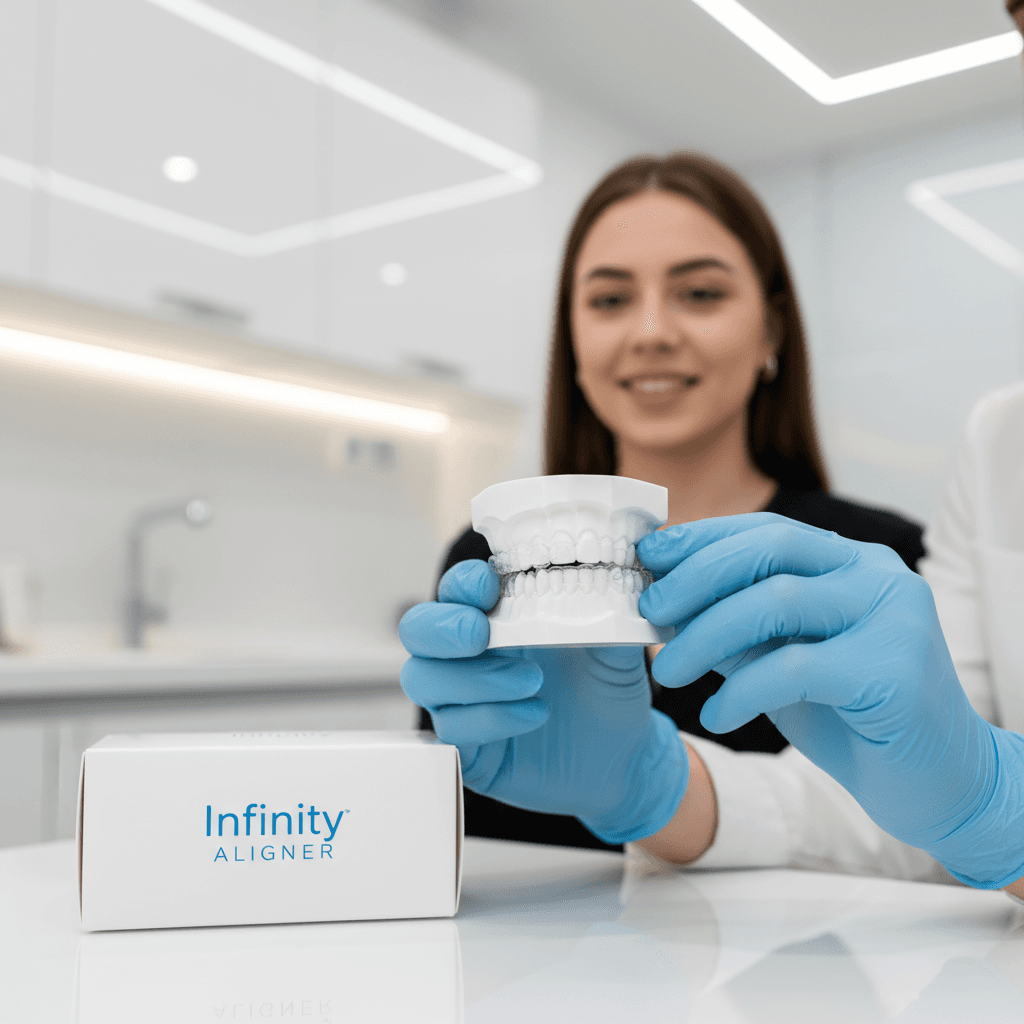
It is one of the most frequently asked questions in orthodontic consultations from adult patients: can I whiten my teeth while wearing aligners? The answer is yes — and even: the orthodontic tray is an ideal vehicle for whitening gel. But as with any clinical protocol, the right answer depends on the right timing, the right product and the right method.

1. Why Aligners Are Almost Perfect Whitening Trays

Dental whitening — whether in-office or at home — relies on the same principle: a peroxide-based gel (carbamide or hydrogen) is held in close contact with the enamel surface for a defined period. This close contact is precisely what a well-fitting thermoformed tray guarantees. An aligner tray, custom-fabricated on precise patient models, provides a near-perfect contact seal between the gel and the labial surface of the teeth — far superior to a generic over-the-counter tray. In theory, a patient wearing aligners therefore already has an optimal whitening device at their disposal. In practice, a few fundamental rules must be followed.

2. Which Products to Use — and at What Concentration?

Not all whitening gels are compatible with orthodontic aligner wear. The basic rule is concentration:

ProductConcentrationAligner compatible?Recommended contact time
Carbamide peroxide10% (= 3.6% H₂O₂)Yes ✅ — recommended standard6 to 8 hours (overnight wear)
Carbamide peroxide16% (= 5.8% H₂O₂)Yes ✅ — under practitioner supervision2 to 4 hours
Carbamide peroxide22% and aboveNot advised ⚠️ — sensitivity riskShort protocol, monitoring required
Hydrogen peroxide3 to 6%Yes ✅ — short contact onlyMaximum 30 to 60 minutes
Hydrogen peroxide≥ 15% (in-office use)No ❌ — professional use onlyIn-office session only
Whitening stripsVariableNot compatible (do not layer)Use without aligners

10% carbamide peroxide applied during overnight wear of the retainer (or the last aligner in the treatment series) is the safest and best-tolerated protocol for a whitening + aligner combination.

3. At What Point in Treatment Can Whitening Begin?

The question of timing is crucial. Several strategies exist depending on the treatment phase:

Before Treatment

Pre-orthodontic whitening is technically possible but not widely advised. The colour of whitened teeth serves as a reference for future restorations (crowns, bonding composites for attachments) — a shade that may shift in the weeks following cessation of whitening. Furthermore, peroxide gel temporarily weakens the bonding of orthodontic attachments if applied within 48 hours prior to their placement.

During Treatment (Active Phase)

This is the most popular and effective strategy. The patient uses the current aligner (the last aligner worn before a series change, typically in the evening) as the gel carrier. Important: gel should not be applied to an aligner bearing active attachments (attachments create gel retention zones that can cause sensitivities). Whitening is therefore recommended from the middle of treatment onwards, once the most significant movements have been performed and the most bulky attachments removed.

At the End of Treatment or During the Retention Phase

This is the ideal time. The clear retainer is a perfect vehicle: well-fitting, without attachments, worn at night. The patient can begin a 10% carbamide gel whitening protocol upon receiving their retainer, for a duration of 2 to 4 weeks.

4. Contraindications and Precautions to Know

  • Pregnancy and breastfeeding: whitening is contraindicated as a precaution
  • Significant dentinal sensitivity: start with a desensitising toothpaste 2 weeks before the protocol
  • Untreated cavities or defective restoration margins: gel infiltrates compromised areas — cavity treatment must precede whitening
  • Gingival recession: gel can cause sensitivity on exposed dentine areas
  • Devitalised teeth (root canal treated): do not whiten with external peroxide — an internal whitening protocol is required
  • Composite resins and ceramics: no peroxide effect on existing restorations — a colour mismatch between natural tooth and crown may appear

5. Expected Results: How Many Shades Whiter Can You Expect?

A 10% carbamide whitening protocol conducted over 2 to 4 weeks achieves an average of 2 to 6 shades of lightening on the VITA scale (the reference standard in prosthetic dentistry). Factors influencing the result include the initial tooth shade (naturally yellowish teeth respond better than tetracycline-related grey shades), the duration of the protocol, the regularity of whitening tray wear and dietary hygiene during the treatment period (avoiding chromogenic foods: coffee, tea, red wine, turmeric).

6. Whitening and Infinity Aligner: A Synergy Built From the Start

At Infinity Aligner, teeth whitening is integrated as an option within the overall treatment plan. The clear retainers delivered at the end of treatment are designed with a slightly reinforced labial seal to maintain carbamide gel in optimal contact with the visible tooth surfaces. The practitioner prescribes the gel appropriate to the patient's sensitivity level and defines the personalised whitening protocol, included in the final treatment summary. The objective: that the patient completes their treatment with not only aligned teeth, but a truly transformed smile.

Infinity Aligner OKC

Ready to get started?

Join 50+ certified providers across Oklahoma. Free certification, 10-day turnaround, dedicated clinical support.