
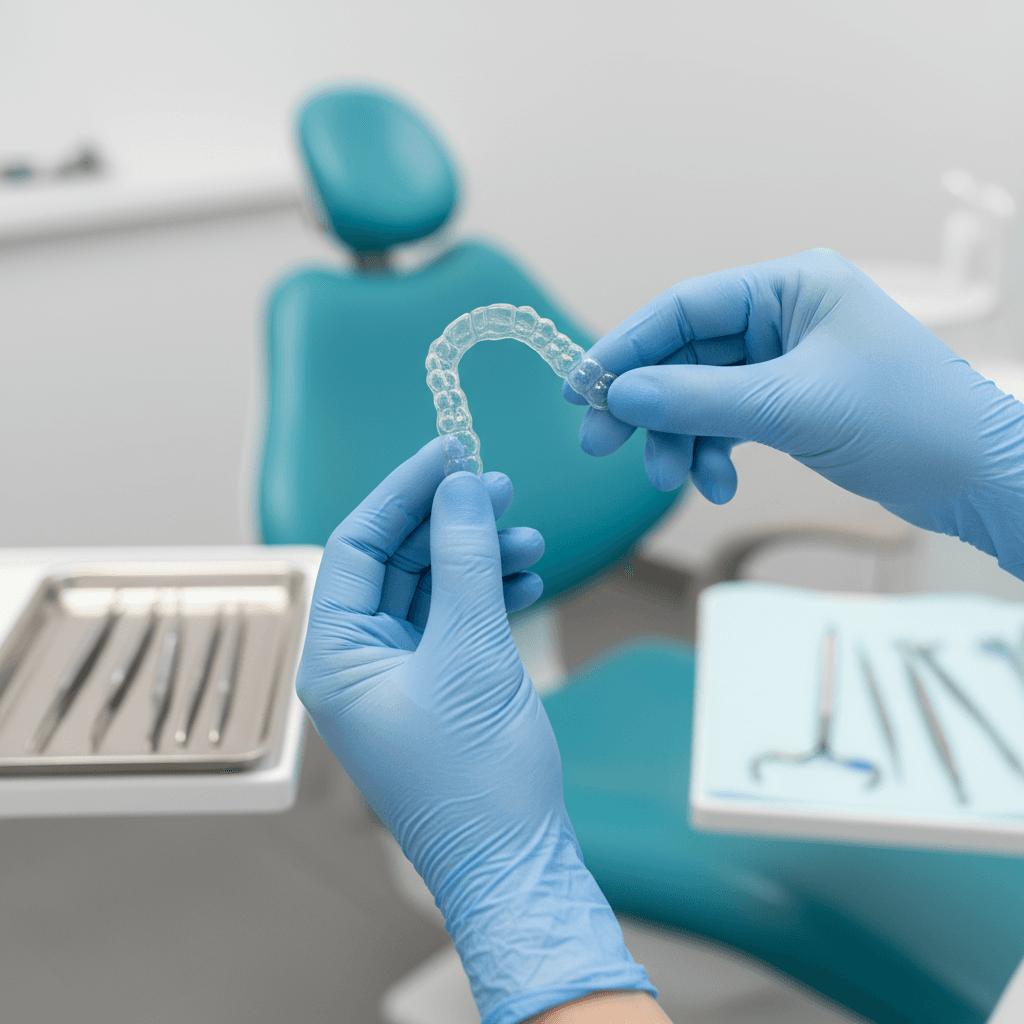
After months of orthodontic treatment — whether with clear aligners or fixed braces — there is a strong temptation to consider that the work is done the day your practitioner announces the end of the aligner series. This is a common mistake, and often a costly one. Post-orthodontic retention is the phase that determines the longevity of the entire treatment. Without it, teeth have a natural tendency to return to their original position — a phenomenon orthodontists call relapse.
1. Why Do Teeth Move After Treatment?
Teeth are not rigidly anchored structures in bone. They are held in place by the periodontal ligament — a network of elastic collagen fibres connecting the root to the alveolar bone. During orthodontic treatment, these fibres are stretched, compressed and progressively remodelled. At the end of treatment, bone remodelling is complete, but the ligament fibres — and especially the superficial gingival fibres — retain an "elastic memory" that tends to pull teeth back towards their original position. This is a physiologically normal and predictable phenomenon. It does not signify treatment failure; it simply means that retention is an indispensable component of the protocol.
2. The Three Types of Retainer: Characteristics and Indications
The Bonded Lingual Wire (Fixed Retainer)
This consists of a thin stainless steel or fibreglass wire bonded to the inner (lingual) surface of the anterior teeth — typically from canine to canine. Invisible from the outside, it provides permanent, passive retention independent of patient compliance. It is the most reliable retention device for anterior teeth, particularly in cases with a strong tendency to relapse. Its main drawback: it requires rigorous hygiene (use of interdental floss with a floss threader or water flosser) and regular clinical checks to verify bonding integrity.
The Clear Retainer (Essix / Vivera)
Fabricated from the final treatment models, the clear retainer is worn at night (8 hours) indefinitely — often for life, at a rate of a few nights per week after the first year. It has the advantage of covering the entire arch (not just the anterior sector as the wire does), being easy to maintain and being able to incorporate a whitening gel if desired. Its main constraint is its total dependence on patient compliance: a retainer that is not worn is an ineffective retainer.
The Hawley Plate (Rigid Removable Retainer)
Less common since the rise of thermoformed retainers, the Hawley plate remains indicated in certain specific cases (correction of an anterior open bite, use in a growing adolescent). It comprises an acrylic resin base and metal clasps on the molars. More bulky than the Essix retainer, it is generally less well received by adult patients.
| Device | Type | Compliance required | Main indications | Recommended duration |
|---|---|---|---|---|
| Bonded lingual wire | Fixed | None | Anterior sector, strong relapse tendency | Indefinite (lifelong if tolerated) |
| Essix / Vivera retainer | Removable | Nightly wear ≥ 8h | All cases, especially post-aligners | Minimum 2 years, ideally lifelong |
| Hawley plate | Removable | Nightly wear ≥ 8h | Open bite, growing adolescents | 12 to 24 months minimum |
3. How Long Should Retainers Be Worn?
The short answer is: much longer than you think. The standard protocol recommended by the majority of orthodontic learned societies (AAO, SFODF) is as follows:
- Months 1 to 6: wear 24 hours a day (except for meals and oral hygiene), or nightly wear of 8 hours if a fixed wire provides daytime anterior retention
- Months 7 to 24: nightly wear of 8 hours, every day
- After 2 years: nightly wear 3 to 5 nights per week, for life
This "lifelong" retention recommendation may come as a surprise — but it reflects an unavoidable biological reality: teeth continue to shift very slightly throughout life, independent of any prior orthodontic treatment. Regular nightly retention is the only guarantee of a stable smile over 20 or 30 years.
4. What Happens if Retention is Stopped Too Early?
Orthodontic relapse — the partial or total return of teeth to their original position — is the main risk of insufficient retention. It is particularly rapid in the first six months following the end of active treatment, the period during which the periodontal ligament fibres are still maturing. In a study published in the American Journal of Orthodontics (2019) following 234 patients over 10 years, 72% of those who had stopped retention before 24 months showed significant relapse, compared to only 8% in the group that maintained regular nightly retention.
5. Retention at Infinity Aligner: Protocol and Follow-Up
At Infinity Aligner, post-orthodontic retention is planned from the very start of treatment — not added as an afterthought at the end. Every treatment plan includes a personalised retention protocol, adapted to the patient's dental morphology, the nature of the movements performed and their lifestyle. The clear retainer is fabricated from the final models — obtained by intraoral scanner — on the very day of the end-of-treatment consultation. For international patients, it is dispatched by express courier upon digital validation of the final models, with no additional visit required.
Never neglect retention. A successful orthodontic treatment without retention is like building a house on foundations you then decide not to consolidate. The active treatment phase corrects; retention preserves. The two are inseparable.
Infinity Aligner OKC
Ready to get started?
Join 50+ certified providers across Oklahoma. Free certification, 10-day turnaround, dedicated clinical support.
